

TL;DR
An onsite event content studio is best for events that need branded photos, video clips, executive assets, and same-day social content. It outperforms a standard photographer when speed, campaign consistency, and multi-format delivery matter.
Corporate events now produce campaign assets, not just memories. An onsite event content studio combines photography, video, branded sets, editing, and fast delivery inside the venue, turning conferences, launches, galas, and activations into live content engines. Swissmoments supports this model through event media production in Switzerland.
Table of Contents
What is an onsite event content studio?
An onsite event content studio is a temporary production setup at a live event that captures, edits, brands, and delivers content while the event is still running.
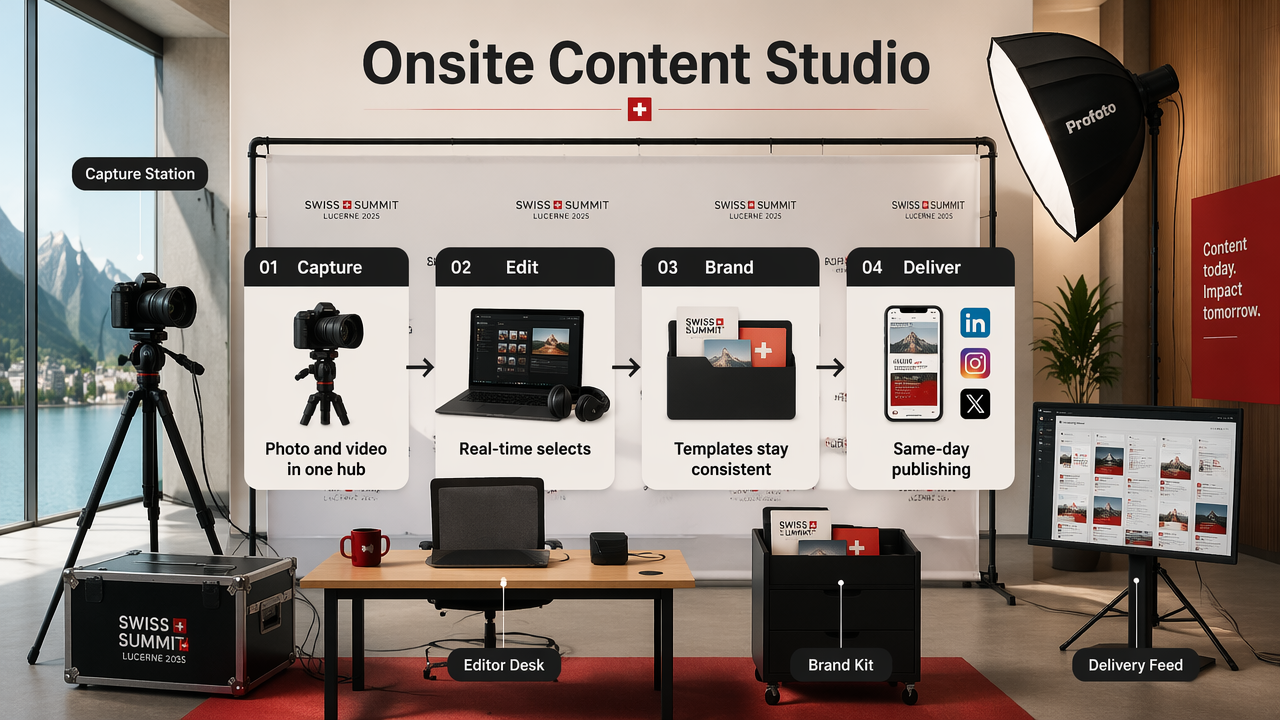
Onsite event content studio: a venue-based photo and video production hub with lighting, backdrops, capture stations, editors, brand assets, and a delivery workflow.
Unlike a classic photo booth, the studio serves marketing, communications, sales, and employer-brand teams. It can produce executive portraits, speaker reels, sponsor clips, customer testimonials, launch visuals, and social-ready edits from one controlled production point.
Research by Patel, Chesmore, and Legner on connected-worker technologies shows how connected tools can support productivity and coordination. Event studios apply a similar logic to content: capture teams, editors, and delivery channels work as one live system.
Key insight: the studio is not a backdrop alone; it is a production workflow placed inside the event.
Core components of the studio setup
| Component | Role at the event | Typical output |
|---|---|---|
| Branded set | Gives every asset campaign context | Portraits, sponsor photos |
| Photo station | Captures people and products cleanly | Headshots, press images |
| Video corner | Records short-form content | Reels, interviews, recaps |
| Edit desk | Selects, crops, grades, exports | Same-day files |
| Delivery system | Shares approved content fast | Galleries, links, social files |
When does it beat a photographer or booth?
A studio beats a standard photographer or booth when the event needs planned content outputs, controlled branding, and fast publishing rather than only broad coverage or guest entertainment.
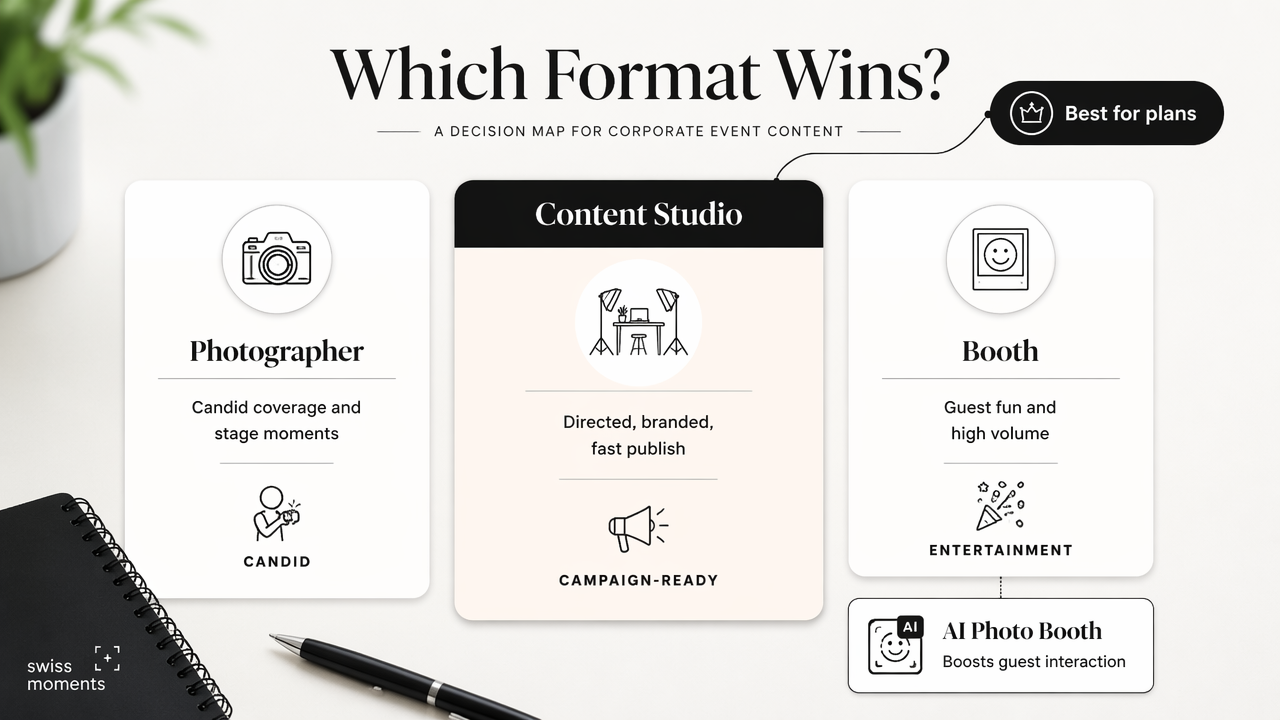
A photographer is still the right choice for candid coverage, stage moments, and documentary storytelling. A booth works well for high-volume guest fun, especially when paired with an AI photo booth for corporate events. The studio fills the gap between both: polished, directed, campaign-ready material.
For corporate teams comparing formats, photography vs videography for corporate events helps define which medium carries the message best. A content studio often combines both, then adds editors and brand control.
Common use cases include:
- Product launches needing same-day media.
- Conferences needing speaker clips.
- Galas needing elegant branded portraits.
- Trade shows needing sponsor and lead content.
- Internal events needing employer-brand assets.
Best-fit decision table
| Event need | Photographer | Photo booth | Content studio |
|---|---|---|---|
| Candid coverage | Strong | Limited | Moderate |
| Guest entertainment | Moderate | Strong | Strong |
| Branded campaign assets | Moderate | Moderate | Strong |
| Same-day edited video | Limited | Limited | Strong |
| Executive content | Strong | Limited | Strong |
How should teams plan the workflow?
A strong onsite production workflow starts with outputs, staffing, and approvals before equipment is booked.
The planning process should define exactly what the studio must deliver: number of portraits, clip formats, file ratios, naming rules, approval steps, and delivery timing. The conference photography best practices framework is useful for aligning shot lists with agenda moments.
Staffing usually includes a producer, photographer, videographer, assistant, editor, and brand approver. Larger events may add a social media manager or sponsor liaison. The Swissmoments platform can support this planning by tying capture goals to event communication needs rather than treating content as an afterthought.
The 2021 EDUCAUSE Horizon Report covered technology trends in digital and hybrid learning environments. For 2026 events, that same expectation shapes content delivery: audiences often expect useful digital assets during and after the physical program.
Minimum planning checklist
- Confirm studio location, power, internet, sound control, and guest flow.
- Build a shot list by audience: executives, speakers, sponsors, guests, products.
- Prepare branded overlays, backdrop rules, file sizes, and approval contacts.
- Schedule editor handoff times for same-day delivery.
- Plan privacy notices and consent, especially for identifiable guest content. For related privacy planning, see the AI photobooth data privacy checklist for Switzerland.
Conclusion
An onsite event content studio gives corporate events a practical way to capture polished, branded, and timely assets without waiting weeks for campaign material. For 2026 planning, teams should define outputs first, then match space, staff, approvals, and delivery. For examples and service direction, visit swissmoments.ch or review the Swissmoments blog.
