

One event can fuel weeks of marketing, if your team plans content before the doors open. In 2026, smart teams treat events as part of content marketing, the practice of creating and distributing content for a target audience, and not as a one-day campaign. Using AI Photobooths in Events alongside planned video, photography, and social capture helps turn attendance into owned media.
Map event goals to content outcomes before production starts
Content strategy guides the planning, development, and management of content, so your event plan should start with business outcomes, not camera angles. For marketing teams, that usually means tying each session, activation, or interview to one purpose: awareness, lead generation, sales enablement, employer branding, or customer retention.

If a content asset has no audience, owner, or distribution channel, don't produce it.
H3: Build a simple content matrix your team can actually use
Create one shared brief across marketing, comms, and event partners. This avoids the common competitor mistake of treating event capture and event promotion as separate workstreams.
| Event moment | Primary asset | Audience | Channel |
|---|---|---|---|
| Keynote | Short highlight video | Prospects | LinkedIn, email |
| Panel discussion | Quote cards and recap post | Existing clients | Blog, newsletter |
| Networking activation | UGC-style photo set | Employer brand audience | Instagram, careers page |
For execution, align your capture plan with corporate video content for marketing, conference photography best practices, and a trusted event media production agency in Switzerland.
Capture content in formats that are easy to repurpose after the event
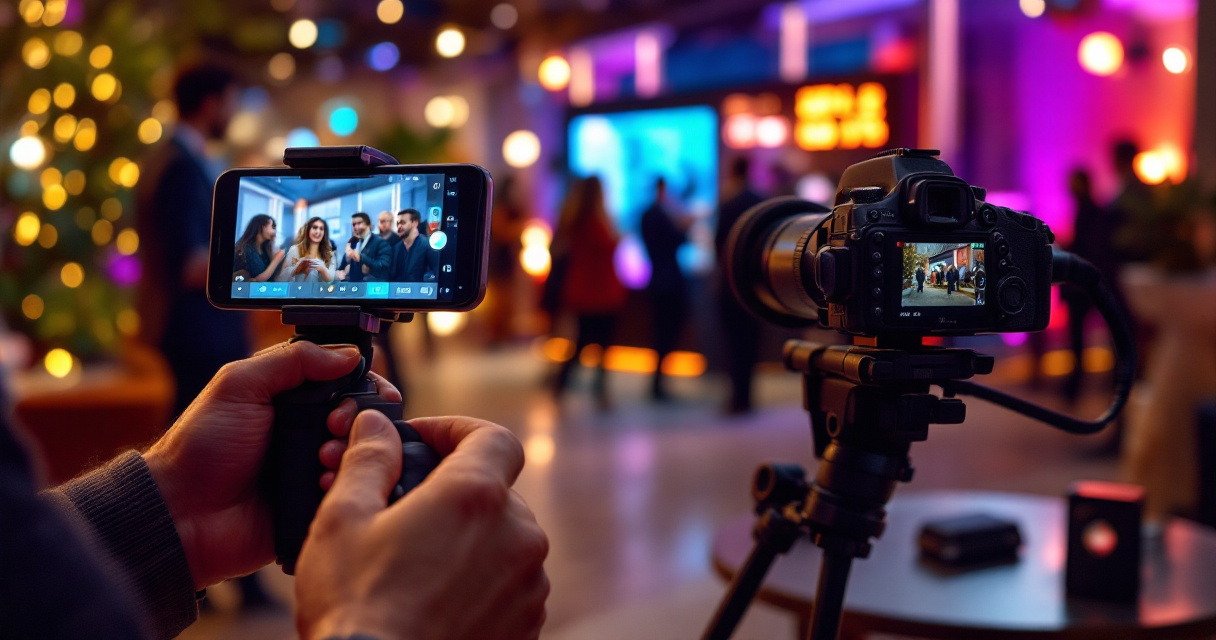
Digital marketing uses digital technologies such as phones, computers, and online platforms, so event content now needs to work across vertical video, blogs, sales decks, and internal comms. That means your production checklist should favor modular formats: 15-second clips, speaker soundbites, behind-the-scenes footage, portrait shots, and branded attendee interactions.
A 2023 opinion paper on generative conversational AI in the International Journal of Information Management examined both the opportunities and risks of AI for research and practice, which matters here because AI can speed up editing, tagging, summarizing, and variation of event assets, but still needs human review for accuracy and brand fit: Dwivedi et al. (2023).
H3: Prioritize content formats that keep working for 90 days
Use a tight capture list:
- 1 hero recap video
- 3 to 5 speaker clips
- 10 to 20 edited photos
- 1 behind-the-scenes reel
- 1 attendee engagement activation
For branded interaction, AI Photobooths in Events can generate shareable visuals on-site while feeding your post-event library. Pair that with behind-the-scenes corporate event shoot ideas and stronger branding through event photography so content feels lived-in, not staged.
Measure event content by reuse rate, not just event-day engagement
Too many teams stop at impressions. A better 2026 model tracks how much event content gets reused across campaigns, sales follow-up, recruiting, and account-based marketing. Competitor articles often mention repurposing, but they rarely give a practical scorecard.
Open-source AI research also shows why production efficiency matters. The 2023 LLaMA paper focused on efficient foundation models, reinforcing a wider trend toward lower-cost AI workflows for content operations: Touvron et al. (2023). That doesn't replace strategy, but it does make faster post-event packaging more realistic for lean teams.
H3: Track these KPIs to prove content value beyond the event
Use a monthly review with four metrics:
- Reuse rate: percentage of captured assets used in later campaigns
- Speed to publish: days from event close to first asset live
- Channel fit: which assets perform best by platform
- Pipeline support: assets used by sales or customer teams
Great event content is not the most polished asset. It's the asset your team uses again and again.
Build your archive in a searchable hub such as your marketing content blog and compare capture needs with photography vs videography for corporate events. Using the AI Photobooths in Events platform can also add measurable attendee-generated content to that mix.
Conclusion
A stronger event content strategy starts before the venue opens and keeps working long after the final session. If you want more usable event assets, plan your next production around clear outcomes, repurposable formats, and measurable reuse, then explore AI Photobooths in Events or contact the Swiss Moments team to turn live experiences into lasting marketing content.
