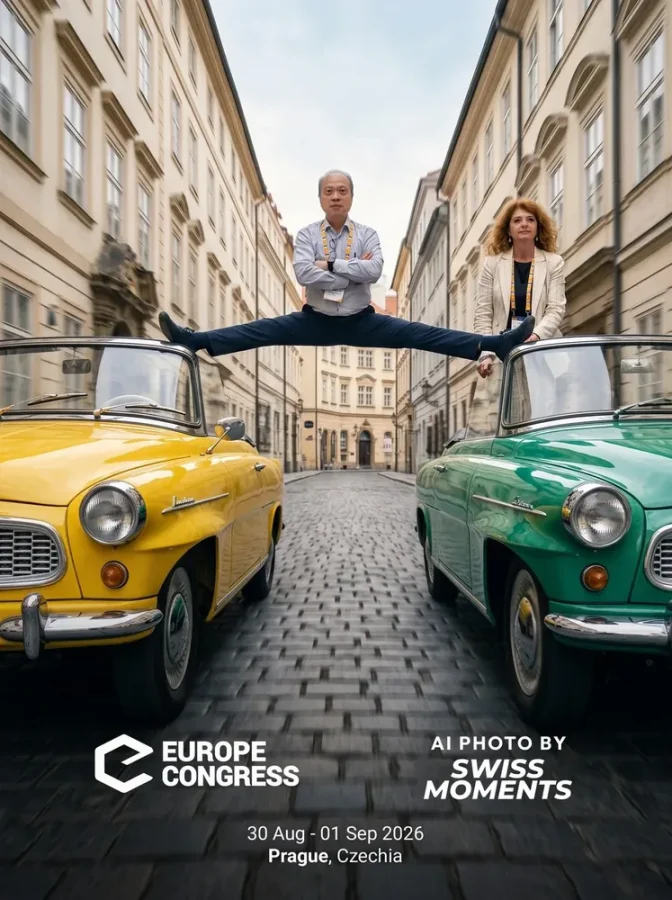

At three Europe Congress events in 2026 – Copenhagen, Düsseldorf and Prague – our AI photo booth created 471 personalised portraits. A photo was usually ready in about one to one and a half minutes, the busiest day brought 88 portraits, and five themes per event were enough.
Congress organisers ask us the same three questions: how many guests will actually use an AI photo booth, how long do people wait, and is it worth the floor space? Instead of general advice, here are the numbers from three congresses we ran in 2026.
The numbers at a glance
| Congress | Dates | AI portraits | Busiest day | Photo ready in |
|---|---|---|---|---|
| Copenhagen | 11–14 April 2026 | 224 | 88 | ~1.5 min |
| Düsseldorf | 6–9 June 2026 | 163 | 70 | ~1 min |
| Prague | 30 Aug – 1 Sep 2026 | 84 | 50 | ~1.5 min |
| Total | 11 event days | 471 |
Numbers come straight from our booth software. “Photo ready in” is the typical time from taking the photo to the finished AI portrait.
What we learned
1. The last day is the busiest
In Copenhagen the final day brought 88 portraits – more than twice as many as the first. Word spreads: guests see their colleagues’ portraits on phones and come to the booth themselves. Plan staff and placement for the last day, not the first.
2. Five themes are enough
Each congress ran with about five scenes (six in Prague). More choice slows the queue. A few themes that fit the city and the audience keep it moving – and every picture still looks different, because each image is generated new.
3. Local themes win
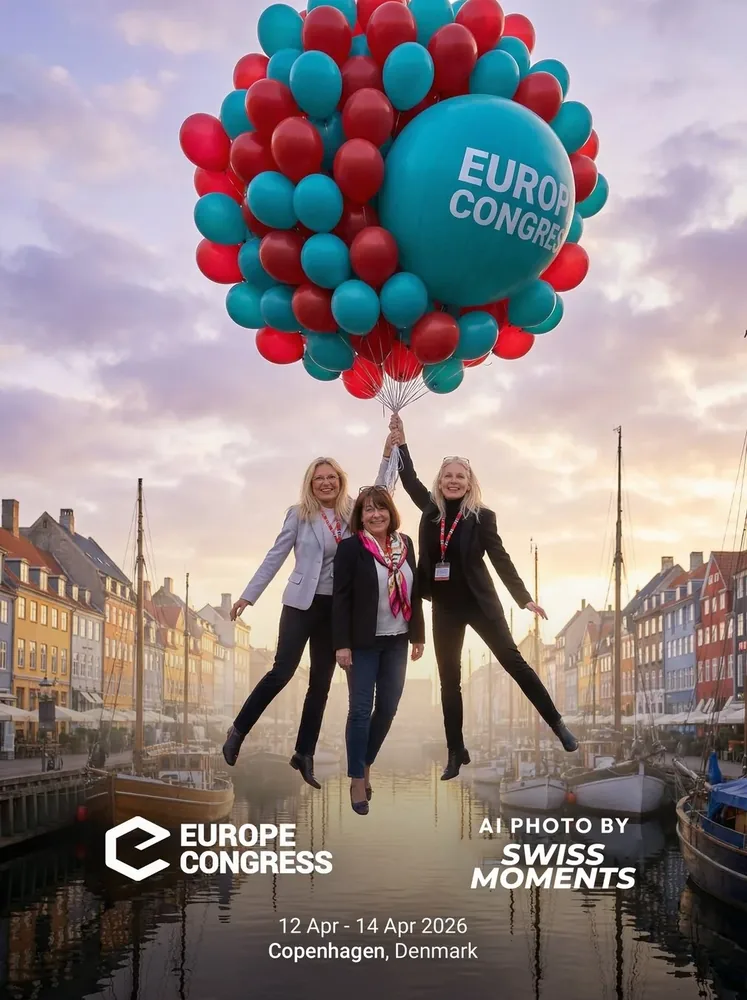
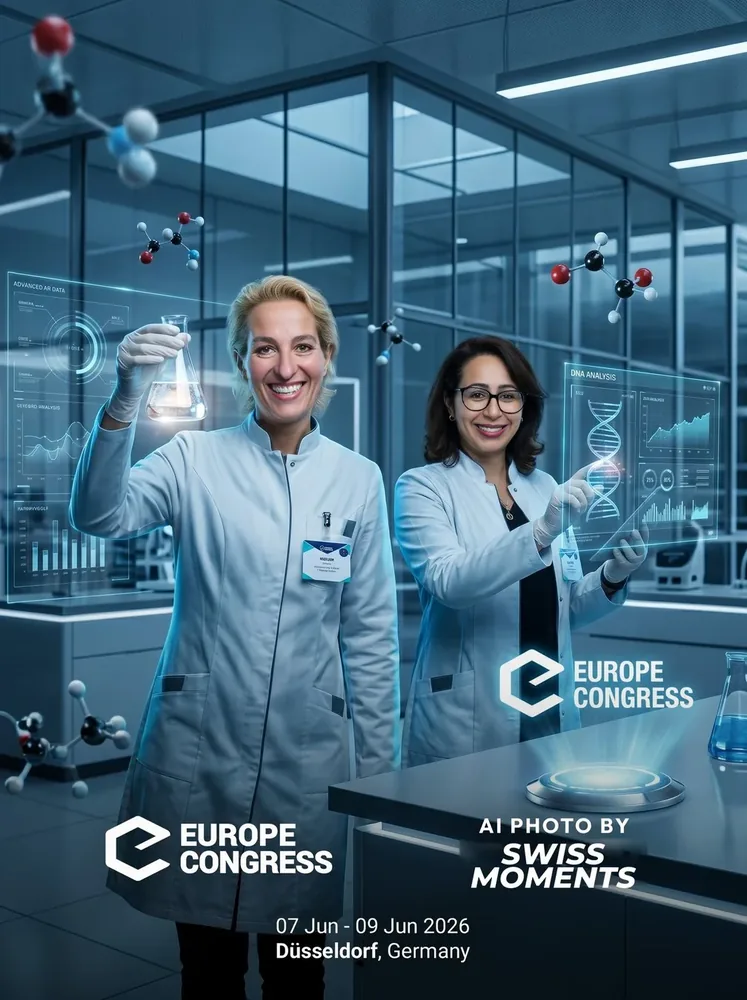
Nyhavn’s colourful houses in Copenhagen, vintage cars in Prague, a futuristic lab for a science audience in Düsseldorf. Guests like to share pictures that show where they were and why they were there.
4. Groups make the best pictures
Several colleagues can step in together, and every face stays recognisable. Group shots are the ones that end up on LinkedIn – which is exactly the reach organisers and sponsors want.
5. Waiting is not the problem
About a minute per photo sounds long, but nobody has to stand at the screen. Guests scan a QR code, walk back to the coffee break and get the picture on their phone.
How the AI photo booth works at a congress
- Step in – alone or with colleagues.
- Choose a theme on the screen.
- The AI creates a new picture in about a minute – new scene, outfit and light, while faces stay true.
- Get it on your phone via QR code, and as a print if you book printing.
The booth runs on our own app, built on the latest generative AI. It does not paste a face into a ready-made template – every picture is made new, for that guest. See the AI photo booth.
Checklist: an AI photo booth at your congress
- Place it on the main coffee-break route, not in a side room.
- Pick 4–6 themes: one local, one linked to your topic, one just for fun.
- Put your logo and the congress name on every picture.
- Decide early: digital only, or prints as well.
- Plan for the last day to be the busiest.
- Add one line to the programme or app: “Get your AI portrait at the booth.”
- Agree with us how long pictures are stored and who can see them.
Also read: AI photo booths at trade shows and conferences.
Frequently asked questions
How many guests use an AI photo booth at a congress?
At our three Europe Congress events it was between 84 and 224 AI portraits per congress over three to four days. The busiest single day produced 88 portraits.
How long does one AI photo take?
Usually about one to one and a half minutes from the photo to the finished portrait. Guests get it on their phone via QR code, so they don’t have to wait at the booth.
Can several people be in one photo?
Yes. Several people can step in together, and every face stays recognisable.
Do you work outside Switzerland?
Yes. We are based in Switzerland and work across Europe – these three congresses were in Denmark, Germany and the Czech Republic.
Planning a congress or conference?
We bring the AI photo booth, the themes and the team – in Switzerland and across Europe.
Swiss Moments – AI photo & video booth, event photography and business portraits in Switzerland. More than 10 years behind the camera and over 500 events.