

TL;DR
A strong event content approval workflow assigns each asset to the right reviewer, sets fast turnaround targets, and separates low-risk social content from legal or executive content. Event teams should pre-approve brand rules, use tiered review paths, and centralize feedback before publishing.
Event content loses value when approvals arrive after the audience has moved on. An event content approval workflow is an orchestrated, repeatable process for reviewing photos, clips, captions, sponsor assets, and executive content before release, adapted from the general workflow concept described in process research. Swissmoments supports event teams that need fast media delivery without losing brand control.
Table of Contents
What is an event content approval workflow?
An event content approval workflow is a role-based review process that moves event media from capture to publishing with clear owners, risk levels, deadlines, and approval evidence. It should cover live posts, recap videos, press images, sponsor deliverables, internal updates, and executive communications.
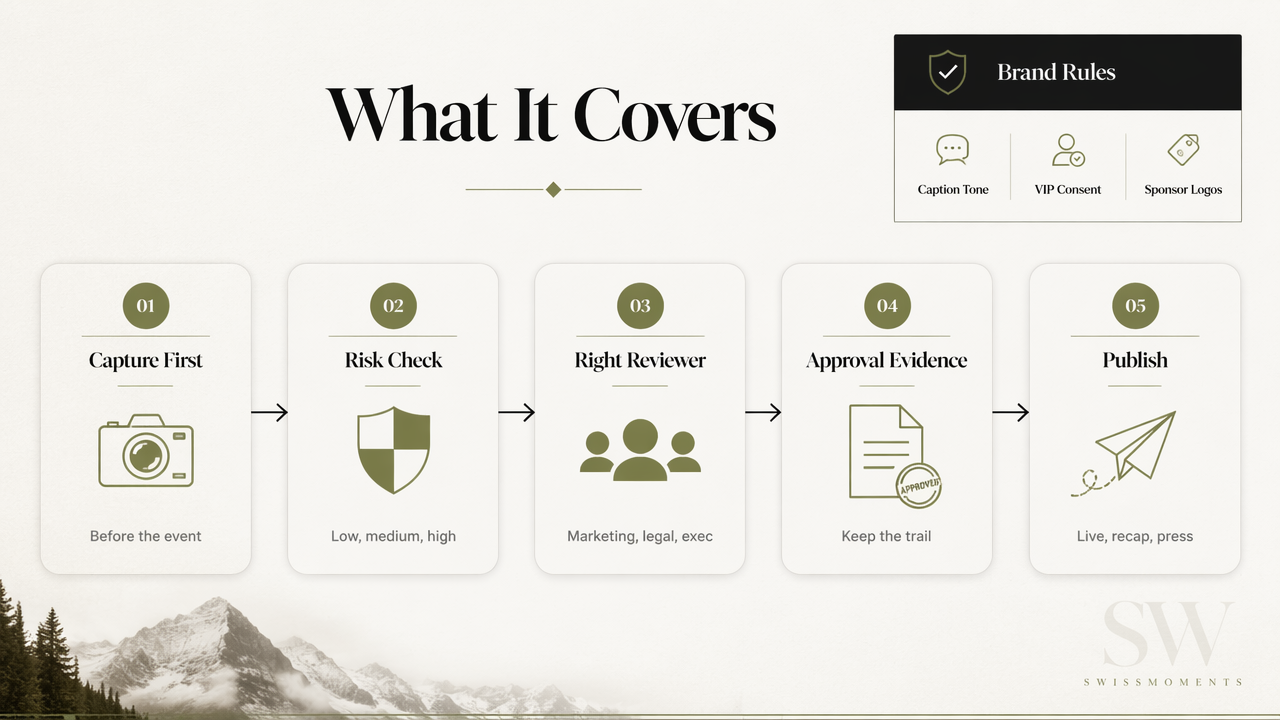
The workflow must begin before the event. A practical setup includes brand rules, caption tone, restricted topics, sponsor logo rules, VIP consent requirements, and escalation contacts. For visual consistency, teams can pair the workflow with an event photography style guide for brands.
Key insight: approval speed improves when reviewers approve rules before the event, not every small creative choice during the event.
Core roles and approval ownership
A simple ownership model keeps live-event review moving:
- Content producer: selects photos, clips, and captions.
- Brand reviewer: checks tone, logo use, colors, and visual style.
- Legal or compliance reviewer: reviews consent, claims, contracts, and regulated statements.
- Sponsor owner: validates partner assets and deliverables.
- Executive approver: reviews CEO, board, investor, or sensitive internal content.
Research on implementation frameworks by Damschroder, Reardon, and Opra Widerquist in Implementation Science supports the idea that successful processes need defined roles, context, and feedback loops.
How should event content move from capture to publishing?
Event content should move through a tiered path that matches review effort to risk. Low-risk atmosphere photos can be approved quickly by marketing, while executive statements, sponsor claims, and attendee data use need stricter checks before publication.
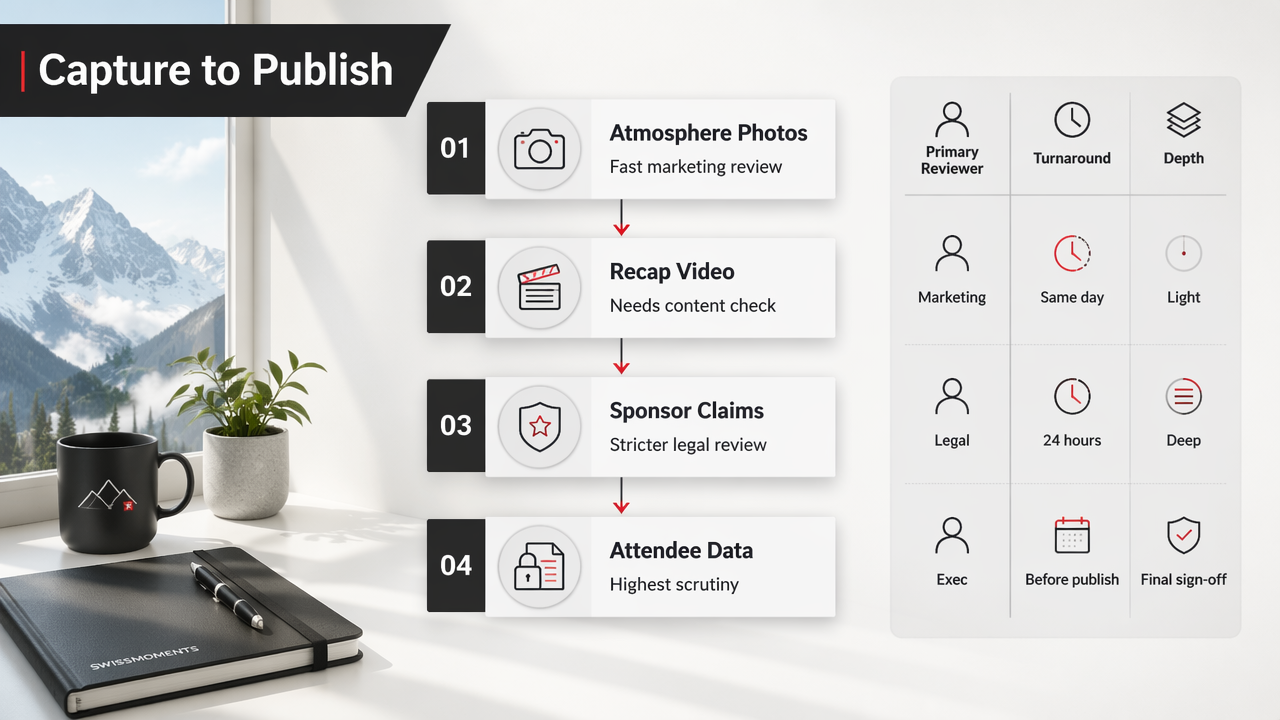
Swissmoments often works best when production, review, and delivery expectations are agreed before doors open. That preparation is especially useful for teams planning corporate event photography in Switzerland or multi-format event videography for corporate events.
Sample approval matrix for event assets
| Asset type | Primary reviewer | Target turnaround | Approval depth |
|---|---|---|---|
| Social photo | Brand reviewer | 15-30 minutes | Crop, logo, consent check |
| Short recap clip | Marketing lead | 1-2 hours | Story, music, captions, brand fit |
| Sponsor asset | Sponsor owner | Same day | Logo, placement, contractual use |
| Executive quote | Communications lead | 2-4 hours | Message accuracy and tone |
| Legal-sensitive content | Legal or compliance | 24-48 hours | Claims, consent, rights, risk |
A practical sequence is:
- Tag assets by type and risk.
- Route each item to the correct reviewer.
- Collect comments in one place.
- Approve, reject, or request edits.
- Store final files with approval notes.
AI can help sort images and draft captions, but human review remains important. A 2021 review of deep learning by Alzubaidi, Zhang, and Humaidi in the Journal of Big Data examined deep learning concepts, applications, and challenges, which is relevant when teams consider automated content screening.
How can teams balance speed with legal control in 2026?
Teams can balance speed with control by separating pre-approved content lanes from sensitive review lanes. The fastest systems do not treat every photo, clip, caption, and sponsor file the same; they define what can go live quickly and what needs documented approval.
For 2026 events, privacy and AI-generated media need special handling. A useful companion is the Swiss checklist for AI photobooth data privacy in Switzerland, especially when guest images, consent, storage, or automated outputs are part of the activation.
Controls that protect brand, rights, and momentum
Strong approval control uses practical guardrails rather than slow blanket review:
- Pre-approved caption templates for launches, conferences, and galas.
- Shot lists that mark restricted people, products, or screens.
- Color-coded risk tags for green, amber, and red content.
- Time-boxed review windows for live content.
- Final archives that include usage rights and approval history.
Best practice: red-lane content should wait for the right reviewer; green-lane content should not sit in the same queue.
Large language model research by Singhal and colleagues in Nature examined knowledge encoded in advanced models. For event teams, that reinforces a practical point: AI assistance can support review, but final publishing decisions still need accountable human owners.
Conclusion
A strong event content approval workflow gives marketing, legal, sponsors, and executives a shared operating system for live and post-event media. For broader planning, teams can connect approval rules to corporate video content for marketing and visit swissmoments.ch to align capture, review, and delivery before the next event.
